A new law extends WV's long pattern of state preemption from extractive industry to data centers, stripping counties and towns of authority over certified projects and leaving communities with no information and only a fraction of the tax revenue.
This page introduces the legislative landscape at play in West Virginia data center and microgrid development and what is means for local communities.
The laws
Three laws shape how a data center gets sited in West Virginia. HB 2014 is the one that matters most. It lets the state certify a project in 14 days, removes county authority over it, and denies the public the right to disclosure of project information.
HB 2014: the Power Generation and Consumption Act
Passed April 12, 2025. In effect since July 11, 2025.
Project Certification Two tracks, both decided by the Secretary of Commerce
| High impact data center | Microgrid district | |
|---|---|---|
| Who qualifies | 90 MW or more of critical IT load, in service on or after July 1, 2025 | An area up to 2,250 acres |
| Decision | The Secretary “shall” certify | The Secretary “may” certify |
| What is judged | Only whether the project meets the definition | Economic impact, and need to attract at least two businesses |
| Deadline | 14 days after notification | None stated |
| Limit | None | Two districts, unless over 70% of power goes to data centers |
| Code section | §5B-2-21a, §11-6N-2 | §5B-2-21 |
Power companies inside a microgrid district are exempt from Public Service Commission oversight of rates, certificates, and complaints. The statute says the Secretary’s decision on a district “is final.”
Preemption of Local Control §5B-2-21b preempts local authority over certified projects
The Legislature states its intent “to occupy the whole field.” Counties and towns may not enact, adopt, implement, or enforce any rule that limits a certified project “in any way.” Certified projects are exempt from:
- Zoning, noise, lighting, viewshed, development, and land use ordinances
- County building permits, inspections, and code enforcement
- County licensing
- County or municipal legal jurisdiction, except as the article provides
Transparency Public records exemptions
"Any information provided by a data center pursuant to this section that is identified by the data center as confidential business information shall be exempt from the Freedom of Information Act."
The state keeps a list of certified data centers for the Governor and Legislature, with identifying details removed. The law does not require the list to be public.
Still public: environmental permit records, utility contracts filed with the Public Service Commission, and county deed and tax records — although parts of these are typically redacted.
Taxes Data center incentives and local benefit
Most of the economic benefit from data centers is from taxes. One WV law provides data centers with a 95% tax break and another siphons 70% of the remaining tax revenue to the state.
High-Technology Business Property Valuation Act:
- Taxes data center and microgrid tangible personal property at salvage value, or 5% of the actual value
- Exempts data center and microgrid projects from sales tax for "all purchases of prewritten computer software, computers, computer hardware, servers, building materials and tangible personal property for direct use in a qualified high-technology business."
- 50% to a Personal Income Tax Reduction Fund
- 30% to local communities where projects are located
- 10% to counties per capita
- 5% to an Electric Grid Stabilization Fund
- 5% to a State Economic Enhancement Grant Fund
Note: Of the total property tax revenue collected from data center projects, local communities will receive 30% of 5%, or 1.5% of the property value.
Roll call: final passage of HB 2014 See which officials voted for the bill
The full roll call for final passage, member by member. Choose a chamber to see who voted for it. Please note that this was voted on in 2025, meaning if you district is not there - the official resigned or moved on.
Don't know your district or official? Click here.
Loading the Senate roll call…
Loading the House roll call…
HB 4983 and the certification rule
Passed 2026. Authorizes the rule, 145 CSR 20, that sets what an application must contain.
The inordinate burden provision Disclosure is required. Acting on it is not.
Applicants must identify any physical or geological condition that could place an inordinate burden on a parcel within one mile, and say what, if anything, they would do to offset it. The Legislature added loss of access to water to that definition. The Secretary must consider proximity to schools, churches, homes, businesses, and historic sites.
The rule does not require the Secretary to deny certification over a burden, and offsetting one is optional. Petitions are confidential, so residents cannot read what was disclosed.
Water: no permit, no advance disclosure What DEP told legislators
DEP officials testified that the state has no permitting program for large water withdrawals and cannot control where a developer draws from. Amendments to require advance reporting were rejected in committee and on the House floor.
Large users must register their use after the fact (§22-26-6). Nothing requires disclosure before withdrawals begin, though state law declares the waters a public resource held for citizens (§22-26-3(a)).
Source: W. Va. Code §22-26-3, §22-26-6; Charleston Gazette-Mail, March 2026
Public comment on the bill 39 comments, all opposed
All 39 public comments we reviewed on HB 4983 opposed it. The House passed it 78 to 16.
HB 2002: One-Stop-Shop Permitting
Passed April 9, 2025. In effect from passage.
What it changes Faster permits for applicants; nothing new for the public
- An online Permitting Dashboard for state permits, due by January 1, 2027.
- Applicants can pay extra to fast-track a permit.
- Agencies that miss processing deadlines must refund fees, starting 2027.
- The dashboard becomes the only way to apply after July 1, 2027.
The law lists transparency as a purpose, but the features it describes are for applicants. It does not say whether the public can see pending applications, and it does not change any comment period.
Zoning in West Virginia
About 78% of all jurisdictions and 81% of state's total acres are unzoned. In the Eastern Panhandle, Jefferson County is almost entirely zoned. Berkeley and Morgan are almost entirely not.
| County | Unzoned | Zoned | Protected |
|---|---|---|---|
| West Virginia | 80.6% | 9.0% | 10.4% |
| Berkeley | 89.5% | 1.8% | 8.6% |
| Jefferson | 4.8% | 90.5% | 4.7% |
| Morgan | 90.3% | 0.0% | 9.7% |
Percent of county land area; rows may not total 100 because of rounding. Protected means protected public land. Source: National Zoning Atlas, West Virginia.
How a county adopts zoning Optional, and subject to a voter petition
Zoning is opt-in. A county must first adopt a comprehensive plan, form a planning commission, and hold hearings. The county commission can then enact a zoning ordinance or put it to a vote.
If it enacts the ordinance without a vote, residents have 90 days to gather signatures from 10 percent of eligible voters. If they do, the ordinance only takes effect if a majority approves it.
Since July 2025, none of this applies to a certified project, whether the zoning already existed or is adopted later.
Before and after HB 2014 The Kearneysville Project is not HB2014 certified. The Bedington Project is.
| Kearneysville | Bedington | |
|---|---|---|
| Approved by | Berkeley County Planning Commission | WV Secretary of Commerce |
| When | March 2025, before HB 2014 | February 2026, after HB 2014 |
| County land use map | Growth area with industrial designation | Conservation and rural uses, no industrial designation |
| County review | Yes | None |
Source: [Planning Commission minutes, March 2025]; [Berkeley County Comprehensive Plan, Future Land Use Map]
Local Ordinances
Jefferson County is almost entirely zoned, and despite a lack of zoning Berkeley County, there are still local rules in place to guide and regulate land use management.
Berkeley County Comprehensive Plan
Berkeley County is adopting Berkeley: Prospering Together, the plan that will guide land use for the next 5 years. The theme is largely shaped by resident input: 78% of survey respondents named rapid growth as their top concern, and the plan's vision commits the County to "grow and prosper while preserving its natural resources, tight-knit community, and exceptional quality of life." That is a strong foundation. On data centers, however, the plan offers no protections, and the public hearing is the time to change that.
What the plan gets right
- Clear maps of where growth belongs. The plan sorts the County into Conserve, Sustain, and Grow areas. Public utilities are not to be extended into Conserve or Sustain areas. Conserve areas are meant to be "protected from development," and in Sustain areas the plan states plainly that "new, large subdivisions and industrial uses are not appropriate."
- The Bedington site is not marked for development. The County's own GIS suitability analysis (Map 8.1) labels the site an unsuitable development area, and the Future Land Use Map (Map 8.2) places it in Conserve/Sustain. The County's own data supports keeping this land as it is.
- Water protection. The plan calls for the Berkeley County Public Service Water District to review site plans so that new development is not permitted without measures to safeguard source water and address water system capacity (Strategy 3.4.2).
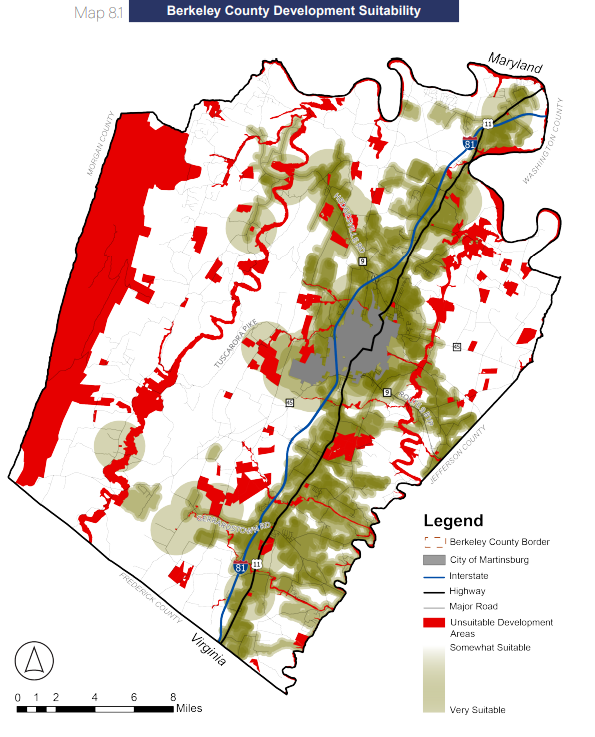
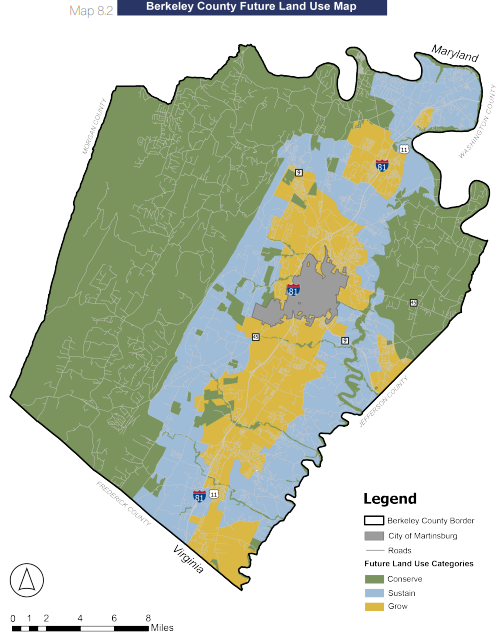
Maps: Berkeley County Comprehensive Plan Final Draft (Sept. 8, 2026), pp. 87 and 94. Select a map to view it full size.
What the plan lacks
Data centers appear once in the plan's strategies, in the economic development chapter:
"Prepare for data center development by ensuring that planned industrial areas have adequate utilities and infrastructure and work with the state legislature to promote smart siting policies and adherence to community priorities and future land use planning."
There are no standards for water use, power demand, noise, setbacks, or public notice. Residents raised these concerns during the planning process and in the final public hearing.
The maps alone will not protect Bedington
- The plan is guidance, not law. It does not carry regulatory force on its own.
- Berkeley County has no countywide zoning. Zoning covers only two small districts, so the Future Land Use Map has little to enforce it.
- The plan admits state law can override it. In its own words, "certain West Virginia state and federal laws can override or significantly limit the County's ability to conserve land by requiring siting of certain large commercial and industrial uses." Learn how state law affects local control.
Local Action
Several community members showed up to the public hearing to comment on th plan. Speakers raised concerns over a lack of data center guardrails and the lack of a mechanism that enforces the plan's vision. The commission was asked to directly address data center development with the addition of guardrails modeled after the document that passed the Jefferson County Commission unanimosly on October 1, 2026.
View the full Berkeley County Comprehensive Plan .
Jefferson County Good Neighbor Data Center Guardrails
What happened, and when
The laws, the rule, and the two Eastern Panhandle projects in order.
2025
-
March
Berkeley County approves the Kearneysville concept plan
Berkeley County Planning Commission
-
April 9
-
April 12
-
July 11
HB 2014 takes effect
County authority over certified projects ends
-
November 10
Commerce files the certification rule as an emergency rule
Takes effect within weeks, without the inordinate burden language
-
November 17
Bedington Owner LLC registers to do business in West Virginia
-
December 10
Comment period on the rule closes, with about 935 comments
Department of Commerce
2026
-
January 29
Rule refiled with the inordinate burden provision
After objections from the Legislative Rule-Making Review Committee
-
February 17
-
Nov 2025 – Feb 2026
No public notice, hearing, or comment found on Bedington
HB 2014 does not require pubic notice
-
February 26
Bedington becomes the state’s first certified data center
548 acres, certified under the emergency rule
-
March 27
-
September 21
Final draft County Comprehensive Plan approved during a public hearing of the Planning Commission.
The Comprehensive Plan designates the site where the Bedington Project is located as Sustain/Conserve and unsuitable for development.
-
October 22
Berkeley County Commission Public Hearing on Comprehensive Plan Final Draft.
Local residents expressed concerns over a lack of data center guardrails and enforceability of the county land use management plan.
Notice and comment
Legal notice and effective notice are different things. A requirement can be satisfied in full while almost no affected resident learns of it.
| Decision | Public notice | Comment period |
|---|---|---|
| Data center or microgrid certification | None | None |
| State air permit | One newspaper legal ad | 30 days; a public meeting can be requested |
| Army Corps individual permit | Posted online by the district | 15 to 30 days |
| Army Corps nationwide permit | Often none for the specific project | Often none |
| Utility special contract | Public Service Commission docket | Through the case |